

Connections Puzzles for School Library Month!

Someone asked me recently about the origins of School Library Month, and I had to admit that I didn’t really know. Beyond the basics like it’s celebrated each April as a way to recognize the vital role school librariansl, my cognitive tank was empty. So, like any good librarian, I decided to do some research. Here’s what I learned:
First established by the American Association of School Librarians, this month-long celebration grew out of earlier efforts like School Library Day, expanding the spotlight from a single day to a sustained opportunity to advocate for libraries and the people who lead them. Like a lot of ALA’s advocacy efforts (in my view, anyway), School Library Month focuses primarily on visibility. It is a chance to highlight how school libraries support reading, inquiry, creativity, and connection. It also invites school communities to see the librarian as more than a bespectacled book shelver.
After all, school librarians help learners build identities as readers, thinkers, and creators. They support students and staff in the work of understanding and evaluating information. They build lessons fueled by authentic inquiry, and they collaborate with classroom teachers to help students see how learning connects across content areas and into the wider world. And in their spare time, they hustle to secure funding, review professional resources to curate developmentally appropriate, reader-centered collections, and after a long day, often with no breaks or support, they share their work on social media in order to inspire their colleagues.
Whew! I’m tired just typing all that out. No wonder we need an entire month to celebrate school libraries and the librarians who make them so special.
More seriously, I believe that what school librarians do best is connect. They connect readers to stories, learners to information, and communities to one another. In many ways, they serve as conduits to some of the most important resources on Earth. What’s more, they make sure that everyone, regardless of what they look like, what they believe, who they love, or how much money they have, has equitable access to everything the library offers.

And Speaking of Connections...
For those who aren’t familiar, Connections puzzles are word games where players are given a set of terms and asked to sort them into groups based on shared relationships. When the New York Times introduced these puzzles in 2023, they quickly became a daily habit for many of us who love words and get a kick out of noticing patterns. At first glance, the words can feel unrelated, which is part of the challenge. The real work is in looking closely, recognizing connections, and trying not to throw your phone when you get it wrong! What’s more, I know many people who belong to daily Connections text groups where friends share their scores, tossing compliments and throwing shade as needed.
In many ways, Connections puzzles mirror the kind of thinking we want students to do in the library. They invite curiosity, pattern recognition, and a willingness to revise your thinking. They also create natural opportunities for conversation, collaboration, and even a little productive struggle. That combination makes them a powerful tool for learning, especially in spaces like the library, where exploration and discovery are at the heart of the work.
Some of you may remember that I created a series of book-related Connections-style puzzles when I was hosting the Bookelicious Middle Grade Book Club. I had so much fun creating them, but stopped when that monthly event came to an end last year. I wrote more about the process of creating those puzzles here. That said, while I received a lot of positive feedback from those puzzles, I also heard two consistent requests every time I shared them. So, in honor of School Library Month, I decided to answer those requests in this post.
Request #1: Make It About the Library!
One of the most consistent pieces of feedback I received was this: “These are fun, but could you make some that are about the library more generally?” It was clear that y'all wanted puzzles that could be used during library orientations, as part of quick lessons or as a way to help kids understand both the purpose of the library and their role in it.
So, in honor of School Library Month, I created a new set of 10 Connections-style puzzles designed specifically for the school library - but I'm guessing that my public library friends could use them, too. Each one focuses on a different aspect of library learning, from how the space works to how students find and choose books, to how they evaluate information and see themselves as readers and creators.
Here's a list of all 10 puzzles along with their theme.

Exploring spaces, tools, and the roles students can take on as learners
Discovering search tools, displays, and people who support choice
Reflecting on formats, preferences, and reading identity
Building a shared understanding of how we care for books, space, and one another
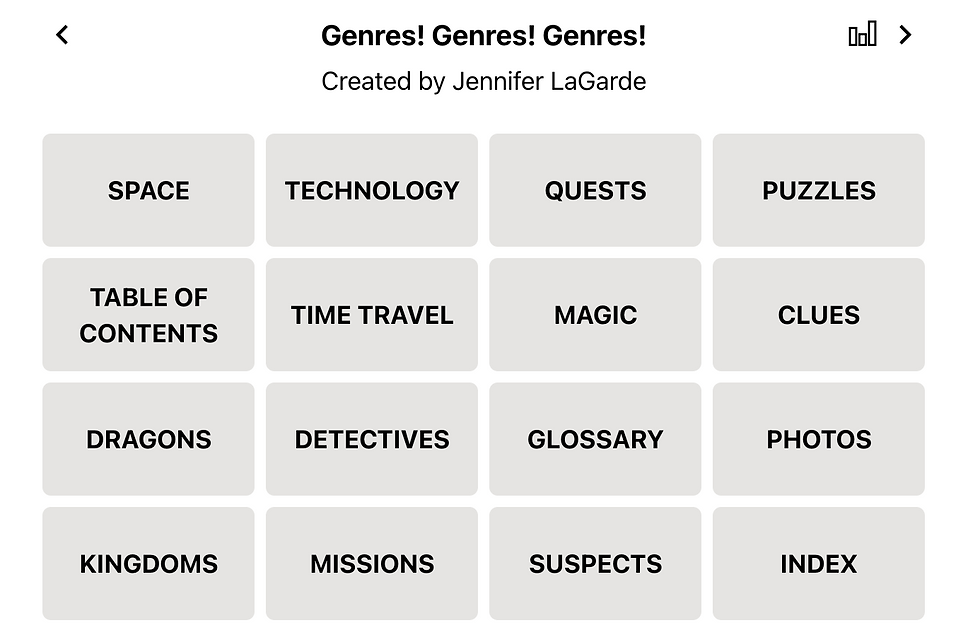
Thinking about interest, fit, and strategies for choosing again
Recognizing genres and text features to support navigation and choice
Noticing the difference between information that informs and influences

Exploring access, representation, and belonging
Highlighting creativity, problem-solving, and hands-on learning
Reflecting on why we read and how we grow as readers
To make these easy to use, I’ve organized everything on a Padlet board. Each puzzle includes a direct link to play, along with an answer key and a short explanation of the thinking behind it. That way, you can quickly decide which puzzle fits your learners and your goals, whether you’re planning a full orientation or just need something meaningful to get a conversation started.
Obviously, not every puzzle I’ve created will be the right fit for every librarian or every group of students. Every library is different, and these were designed for learners ranging from about 4th through 9th grade. With that in mind, here’s my advice:
Review and choose intentionally.
As with any resource shared online, take a few minutes to look through each puzzle and decide what works best for your learners and your goals.
Make them your own!
I used the free tool Connections+ to create these. Honestly, the hardest part was deciding on the clues for each category. Once you get started, it’s a lot of fun.
Proofread before you publish.
Because this tool does not require (or even allow) you to create an account, you can’t go back and edit a puzzle once it’s live. Give everything a careful check before you hit submit.
Request #2: Help Me Scaffold This!
The other request I consistently received had to do with helping kids who weren’t quite ready for the kind of thinking required by a Connections puzzle, which can be deceptively tricky. Pattern recognition takes practice, so it wasn’t all that surprising when I heard things like, “I would love to use these with my students, but they don’t understand how Connections work!”
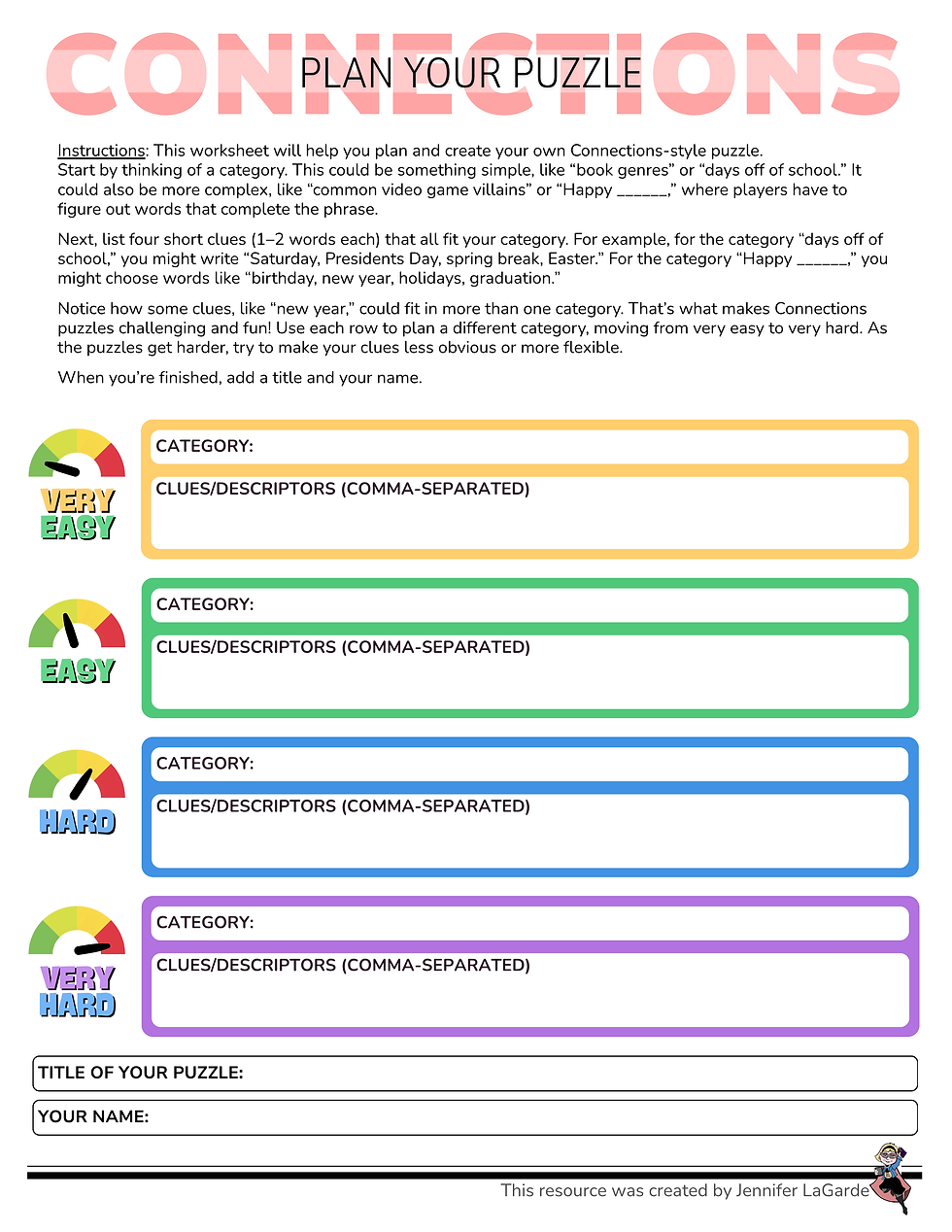
Of course, one way to support this is to have students create their own Connections-style puzzles. When kids build the categories and clues themselves, they begin to understand the “grammar” of how these puzzles work. Focusing on that goal, I created a worksheet a while back to walk students through this process. For this post, I’ve updated that worksheet and created a Canva template so you can easily make your own copy and adapt it for the learners you teach.
Still, I realize that even this can be a bridge too far for students with little to no familiarity with this kind of thinking. I also know many of us are being thoughtful about how much screen time we’re asking of students.
So, for each of the library-related Connections puzzles I shared above, I’ve also created an analog version like this:

Just like with the digital puzzles, students have access to the full set of descriptions. They are also given three of the four categories, with four descriptions left over. Their job is to use those remaining clues to determine the missing category. This structure lowers the barrier to entry while still asking students to notice patterns, test ideas, and make connections.
As with the planning worksheet, I’ve created a Canva template where you can access and adapt all of the analog puzzles.
You may be wondering about answer keys. The answer key for each puzzle, as I designed it, can be found on the Padlet board that links to the digital versions. If you choose to adapt the puzzles for your own learners, you’ll need to create answer keys that match your revisions.
Happy School Library Month
School Library Month is always worth celebrating. This year, however, it feels especially important to recognize just how much school librarians are being asked to carry.
Across the country, school librarians find themselves at the center of ongoing culture wars and the target of disinformation campaigns that misrepresent both their work and their values. And yet, in the face of all of this, school library workers continue to show up for kids. They protect access to stories and information. They create spaces where everyone is welcome, all stories and experiences are celebrated, curiosity is curated, and where every learner has the opportunity to grow as a reader and thinker.
However small, I hope these resources are both useful and a reflection of my deep respect and admiration for school library workers everywhere. Onward!


